The new issue of The Trailmarker is now available.
Don Gabel, our Camp Committee Chair, spoke with David Bourne at Harriman Group Camps. David indicated there may be more positive news soon.
Over the weekend, Gov. Cuomo surprised the State by announcing camping and outdoor recreation is open. David feels the State is working to devise a way to make that happen, and expects the Park will receive new guidelines sooner rather than later. He requested group camps get their plans for opening to him ASAP… and ADKNY will be ready.
More to come!
We’re going virtual since we cannot be at camp at this time. But we still want to share our activities with the ADKNY Community.
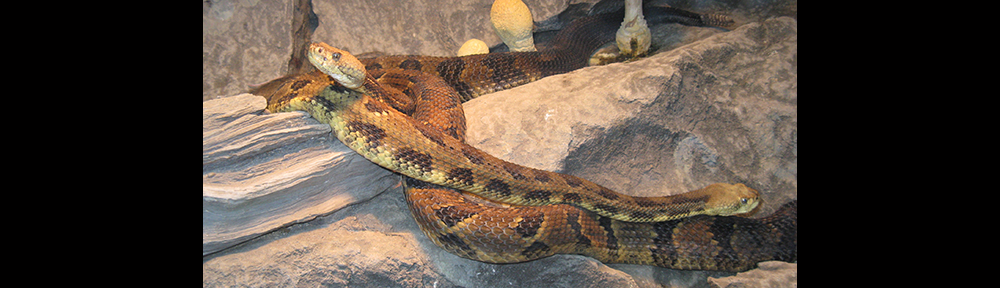
The Activities Committee would like everyone to join a Zoom Talk on Snakes & Reptiles given by MaryLynn Malone from the PIPC Regional Museum on June 27th.
Please see the calendar entry for more details.
Camp Nawakwa has received additional information from the Park. Following their announcement that Harriman group camps may open pending a Park-approved plan, the Park now has decided to follow New York State Parks in their response to opening state camps.
There will be a further delay to opening Harriman group camps. Harriman Park acknowledges that their group camps operate on a different model than most State Park accommodations, but have come to this decision regardless.
Camp Nawakwa’s opening date is a fluid one and we will keep you updated. The Park is asking we submit a plan for opening despite the delay. The ADKNY Board of Directors has finalized a plan and will submit it to the Park for approval next week. When the Park decides to proceed, we’ll already have our plan ready.
Our Camp on Lake Sebago was popular from the beginning.
“Water was the big problem. The pump at the lake with the pipe line to the auxiliary tank provided ample service water. Drinking water was another matter. For this we tapped a weak spring down the road where it dips almost to the lake beyond the parking area. Of course there was no road then. The distance is about 500 yards. All the drinking water was carried up to the house in pails. Light drinkers were the order of the day. Naturally, when the Park water was on it served adequate for drinking. As traffic in the area increased, this spring was abandoned. Then, our only source of drinking water was a spring at the New York University camp – now the family camp. The water squad went over in boats and brought back full pails. A Chinese yoke was devised for bringing pails up from the dock. (1)
On a weekend shortly before Memorial Day a fire broke out near the drinking water spring. A chapter member with a group had lunch and a camp fire at the spot where the forest fire began. The entire camp turned out with pails and other items to help fight the fire and save the camp. Our efforts were successful, but an extensive area to the north and west were badly burned over. (1)
Recognition – Major William A. Welch writes – “I want to assure you that we very much appreciate the work that members of the Club did in helping us fight that fire (at Sebago) and that we realize very fully that the Club as such, is in no way responsible for it.” (2)
“During the first six years of the camp life, there was no road in from the highway. When the lake was clear of ice, the supplies were brought in by boat from a point near the dam. When the ice was good, the large flexible flyers were used to bring in the supplies. One sled had skis attached for use on snow. During all the time between these 2 periods, everything had to be backpacked around the shoreline.” (1)
The headquarters of the NY Chapter was located at 347 Prospect Ave in Hackensack, NJ. We had a headquarters!
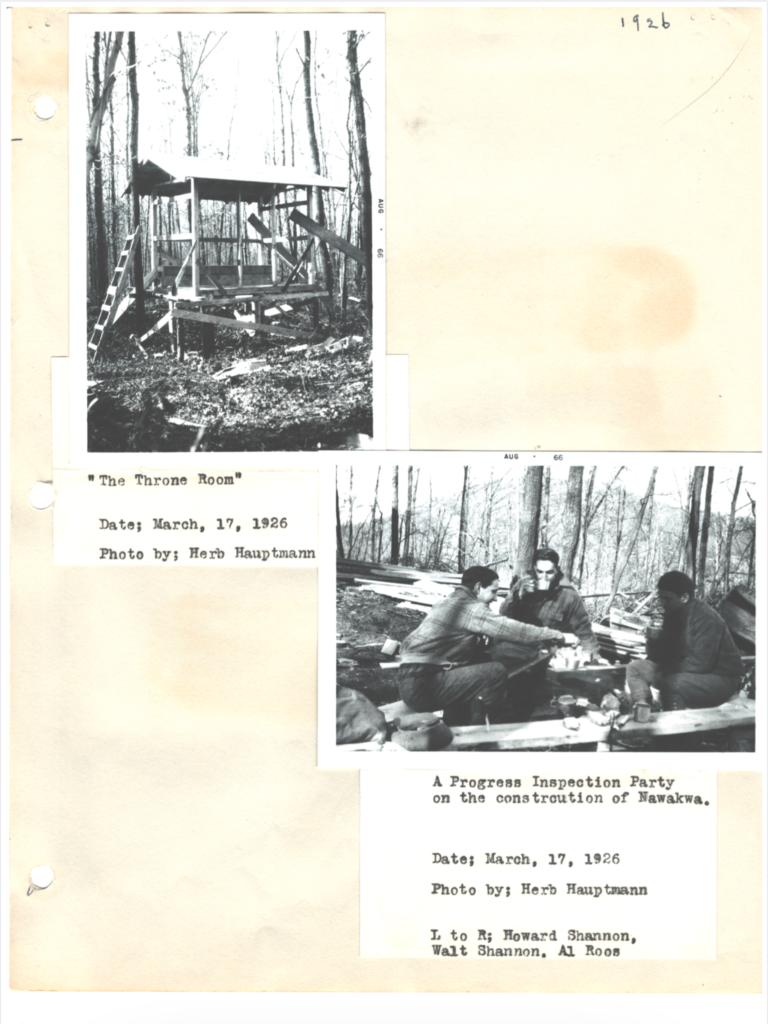
“It did not seem appropriate to continue calling our place “the new camp”, so word went out for a better name with the winner having a free weekend at camp.” We remember that this is the same prize given to the member who name The Trail Marker. “Katherine Williams won the prize with Nawakwa. This is an Indian word meaning “in the midst of the wilderness”. (1)
Should you think that the NY Chapter members were only a rough and tough crowd, the June 21, 1926 issue of The Trail Marker notes: “Cancelled – The “Moonlight Sail” scheduled for Friday, June 25, is hereby officially cancelled by order of ye chairman. The Social Committee investigated the Mandalay and found it wanting in many things, including refinement that the Chapter seeks in all its doings.”
Beginning in 1923, in addition to The Trail Marker, a quarterly booklet was published “Schedule of (Season) Outings”. It was beautifully designed as a four fold, single sheet that easily fit into a pocket. Each issue listed the Chapter leadership and included the weekend hosts, hikes and outings. Each quarterly schedule was ten pages long. The summer schedule was twelve pages long. Every holiday was celebrated at Nawakwa including Valentine’s Day, Lincoln’s Birthday, and Washington’s Birthday. Every weekend there were three to four activities.
And how exactly did one get from the Sloatsburg train station to Nawakwa? “The station agent at Sloatsburg will gladly assist anyone in reaching the dam by auto. The driver may sometimes be found at the barber shop near the station. The fare is $0.50, if there are four or more. Distance about four miles.
Another method of traveling from the city was to take the boat from 132nd St. to Bear Mountain; $0.60 one way on weekdays; $1 on Sundays and holidays.” (3)
Let me know if anyone comes to mind who might like to receive these highlights,
Ellen King
Archivist
Founded in 1923, the Nawakwa Outdoor Association of New York, Inc. is a membership organization dedicated to the enjoyment of the outdoors through hiking, walking, camping, swimming, skiing, sailing, canoeing, and kayaking, and to the conservation and preservation of our wilderness, particularly the mountains, lakes, trails, and camping areas of the metropolitan New York region.